Headlight hijinks
How many paragraphs does it take to change a lightbulb?
A weekend or two ago, I went for a beautiful morning ride with a friend, and he made some comments about being visible on the road. Being that riding a motorcycle is inherently dangerous, this isn’t an uncommon subject, and the factor he chose to bring up here was the imperfect awareness of the other cars on the road. To partially combat this, he suggested that I ride with my high beams on in the daytime, for visibility.
When I got home, I pulled in to the garage, and noticed something off about the cardboard box that was a couple inches in front of where I park the bike - it wasn’t lit up by my headlight. My headlight was off. This isn’t immediately surprising, because there was still plenty of daylight out. Of course I would have my lights off. So, why was this weird? Because with motorcycles, you can’t turn the headlights off 1. When you turn the bike on, the light is on. I believe the theory is that you’d be more visible as a rider if your headlight is on. This was probably a lot more effective before daytime running lights became standard in cars, making the previously motorcycle-exclusive visibility bump kaput. In worse news for my visibility, most car A-pillars are thicker than my thighs and drivers are on their phones - thinking that a running motorcycle headlight will really help visibility is like a pitting a coughing baby against a hydrogen bomb. Regardless, I don’t mind the always-on headlight, but it means you don’t think about switching on or off the lights.
So, the low-beam light wasn’t working, but I could still flick my high beams on. Even if I still had light, I wasn’t going to go around searing the eyeballs of other drivers on the road in lieu of fixing my own problem. Since the high beams still worked, I figured the low-beam fuse, or bulb, had blown. However, when I looked up replacement bulbs, and information about my bike, I learned that it’s just one physical bulb contains both the high beam and low beam light, and also one fuse for all the headlights. Having heard these ridiculous2 claims online of a ‘single bulb to rule them all’ and this dual-filament nonsense, I proceeded to employ the ’trust, but verify’ strategy.
(I was going to have to open up my headlight anyways.)
With an 8mm socket wrench (and the unnecessary turning of a not-related-to-getting-to-the-bulb phillips head screw that’s also accessible from the outside of my headlight assembly) I was able to inspect my bulb. It turns out, there are indeed, two filaments inside the bulb. One is surrounded by a spoon-shaped reflector to focus the light into the normal, dont-blind-other-drivers mode, and the other filament was surrounded by nothing. It was relatively hard to see what was wrong with the non-functional low-beam filament, so I was concerned that it could be a fuse, or (more troublesome to repair,) the wiring. Being optimistic, I just worked on getting a replacement bulb.
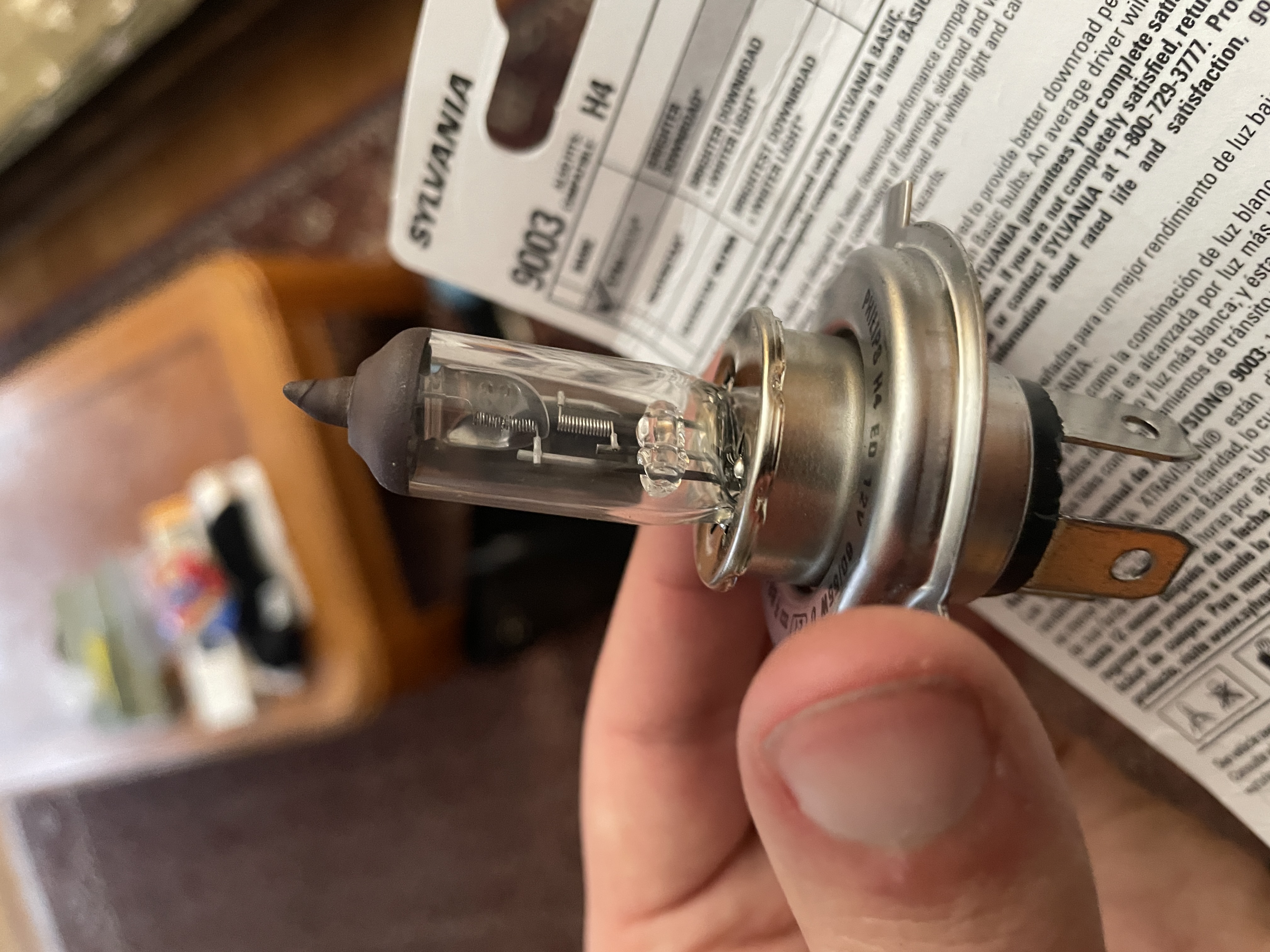
If you look closely, the low beam filament (higher one) looks ‘dirty’ or ‘rusted’, and there’s a crack somewhere in the middle of the spiral section.
Seeing the text on the bulb say it’s a ‘H4’ bulb was helpful, because I found replacements online - but I really wasn’t finding that much. Some digging later found that ‘H4’ bulbs are equivalent to ‘9003’ bulbs. Don’t look at the image and tell me ‘it was obvious, it says 9003 on the box you’re holding. I bought the replacement after I figured all this out. It’s the same socket, the same wiring, but numbering schemes for headlights that came from different markets. 9003 is the American term, and H4 is the European term. More importantly, most manufacturers in the US list their bulbs as 9003 which means searching for 9003 instead of H4 yielded more results.
Many manufacturers sell LED bulbs that fit this socket, but it’s illegal in the US to put LED lights in a fixture that was designed for halogen bulbs. There would be a risk that my lights would shine and dazzle oncoming drivers. It’s funny, considering I already feel dazzled - and not positively - by the irritation of the (stock) LEDs on new cars. To refer back to my other Reagan quote (trust, but verify), one might notice that the NHTSA regulations on vehicle lighting haven’t been adjusted since Reagan was in office, yet somehow, these eye-searing LEDs have seemingly trickled down to everyone. If I wanted LEDs, I could buy a whole new LED fixture, but this was much more expensive, and these modern-looking units felt like they went against the spirit of my bike.
Having figured out what replacement bulb to look for, I was spoiled for choice at my local Autozone. A brand called ‘Sylvania’ offered 4 different trim levels for my specific bulb socket! The internet seemed to recommend the ‘Silverstar’s, but two of the trims have ‘Silverstar’ in their name. The lineup is Basic, Xtra-vision, Silverstar, and Silverstar Ultra. Basic is basic. The box’s complete lack of decoration when compared to the other trim levels is so stark that it makes the basic bulbs look like a bad knock-off of ‘real’ Sylvanias. Xtra-bright’s claim is that it goes farther downroad, compared to the basic trim. Silverstar makes the light whiter, achieved by adding a blue tint to the glass around the bulb. Lastly, Silverstar Ultras claim even more brightness, increasing their downroad throw distance, and some claim of ‘Ultra’ night vision.
Being a muppet, I picked the second tier - the Xtra-brights - because I liked the idea of more brightness, but didn’t want a blue-tinted light.
I got them installed, which wasn’t so bad, except for the fact that the H4 socket from the bike was basically glued to the existing bulb. I got the bulb and plug separated only by sticking a flathead screwdriver in the gap between the bulb and the socket, and twisting until they separated. It slightly chewed up the bulb and socket, but nothing else was working, and I was replacing the bulb either way.
I don’t regret the Xtra-brights because of their brightness, or their price - both of which were perfectly fine. The light’s great, and the price difference was negligible. It was $23 instead of $20 for a single bulb, and for something that should last ‘a while’, that’s nothing. But, right there is the catch. What’s ‘a while’?
When I looked at the back of the packaging the bulb I bought - after I installed it and used it - I saw that the rated runtime for the ‘Xtra-brights’ was listed at 160 hours. The packaging claimed that the typical motorcyclist will ride 100 hours per year, so this should last maybe a year and a half. This seems like a pretty lame lifespan for a bulb, so I checked the rated runtime for the ‘Basic’ bulb.
The basic bulb’s lifespan is rated at a cool 1,110 hours.
I paid 15% more for a light that has an 86% shorter lifespan.
I will have to replace this ‘Xtra-bright’ bulb 9 years earlier than if I had saved $3 and went with the basic bulb.
Oh well. I suppose I’ll be forking over another $20 in a year or so, and I think I know what I’ll buy when the time comes.
1 For motorcycles sold in the US, made after 1976, this is generally true. The bulk of the online discussion about always-on motorcycle lights focuses on 3 countries: Australia, the UK, and the US. In Australia, always-on lights were [required in the early 1990s and made optional a few years later](https://www.webbikeworld.com/brief-history-of-motorcycle-lights-and-laws/#:~:text=In%201992%20Australia%20introduced%20mandatory%20“hard%2Dwired”%20headlights%20for%20motorcycles%20–%20low%2Dbeam%20headlights%20were%20required%20to%20illuminate%20whenever%20the%20engine%20was%20running.%20This%20requirement%20was%20made%20optional%20in%201996%2C%20due%20mainly%20to%20pressure%20from%20motorcycle%20lobby%20groups), because the sun is bright down under, and motorcycle wiring was weak back then. In the UK, they don't have a law explicitly requiring it, but if your motorcycle came with always-on lights, and you change that behavior in any way, you'll fail your inspection. Since most bikes come with it stock, it's effectively a law for the end customer, instead of the manufacturer. In the US, Wikipedia is not [very](https://en.wikipedia.org/wiki/Motorcycle_safety#:~:text=On%20most%20new%20motorcycles%2C%20the%20headlights%20turn%20on%20as%20soon%20as%20the%20bike%20is%20started%20as%20a%20legal%20requirement.) [clear](https://en.wikipedia.org/wiki/Motorcycle_headlamp_modulator#:~:text=This%20is%20not%20required%20by%20any%20federal%20regulation%20but%20rather%20is%20a%20matter%20of%20voluntary%20industry%20policy.) about if the law requires it, because the law itself is not very clear - it is a mix of the [Federal 571.108 standard](https://www.ecfr.gov/current/title-49/section-571.108), and a hodgepodge of state laws implementing a variety of always-on light legislation. Like the UK, it's a common denominator system. Ask GM why it introduced daytime running lights for US-spec cars in the mid 1990s - it wasn't because of US regulation - it was because of neighboring Canada's regulation. GM cleverly advertised this, saying ['We think it's the right thing to do'](https://www.youtube.com/watch?v=b6JuWZMJ_3U), but it was ironically a cost saver, as they could make one car the 'commond denominator' for both markets.
2 Sarcasm